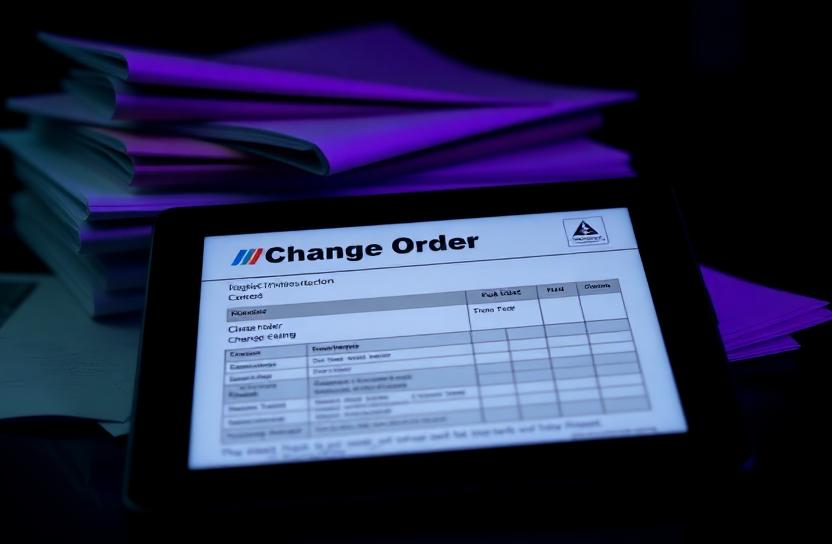
Automating Change Orders in Construction: Stop Losing Money on Manual Processes
Change orders are where construction companies lose money they don't even know they're losing. Automating the process isn't optional for growing contractors.
The Change Order Problem
Every contractor knows change orders are part of the business. Scope changes happen. Conditions differ from what was expected. Owner requests come in. That's construction.
What most contractors don't realize is how much money they lose not from the change orders themselves, but from how they manage them.
Change orders that don't get documented in time. Pricing that's estimated from memory instead of calculated from actual costs. Approvals that sit in email for weeks while the work has already been done. Costs that never make it from the project management system to accounting.
These aren't edge cases. This is how most construction companies handle change orders, and it costs them real money on every project.
How Change Orders Work in Most Companies
Be honest about your current process. It probably looks something like this:
A scope change is identified in the field. The super calls or texts the PM. The PM writes up the change order, usually in a Word document or an email. They attach pricing, often estimated quickly rather than carefully calculated.
The change order gets emailed to someone for approval. Maybe the project executive. Maybe the owner's representative. It sits in their inbox competing with every other email they received that day.
If it's a straightforward change, it might get approved in a few days. If it requires back and forth, it can take weeks. Meanwhile, the work may already be happening because the schedule can't wait for paperwork.
Once approved, someone updates the budget. Maybe in the PM software. Maybe in accounting. Maybe in both, manually, with slightly different numbers because they were entered at different times.
At the end of the project, when final numbers are reconciled, the gaps become visible. Change orders that were never formally documented. Costs that were incurred but never billed. Approvals that were verbal but never captured.
What Automated Change Order Management Looks Like
An automated change order system handles the entire lifecycle:
Initiation. Field personnel or PMs create change orders through a structured digital form. The form captures scope description, cost impact, schedule impact, and supporting documentation in a consistent format every time.
Pricing. The system pulls relevant cost data from your existing records. Historical costs for similar work, current labor rates, material prices. The PM still reviews and adjusts, but they're starting from data instead of guessing.
Routing. Based on dollar amount, project type, or any other criteria you define, the change order automatically routes to the right approvers in the right sequence. A $2,000 change goes directly to the PM for approval. A $50,000 change routes through the project executive and maybe the company president.
Notification and escalation. Approvers get notified immediately. If they haven't responded within your defined timeframe, reminders go out automatically. If the timeline is critical, escalation alerts reach the next level of management.
Financial integration. When a change order is approved, the budget updates automatically in your accounting system. The cost tracking, billing, and job costing all reflect the change without anyone re entering data.
Documentation. Every step is logged. Who submitted it, when it was approved, by whom, and the full history of any revisions. When you need to reference a change order during closeout or a dispute, everything is there.
Building the Business Case
Quantifying the value of change order automation requires looking at a few areas:
Uncaptured revenue. Change orders that were verbally agreed to but never formally documented and billed. Most contractors will admit this happens, even if they're not sure how often.
Approval delays. The cost of work proceeding without formal approval, or work being delayed while waiting for approval. Both scenarios cost money.
Admin time. The hours PMs and admin staff spend creating, routing, tracking, and following up on change orders manually. These are hours that could be spent on productive project management.
Reconciliation costs. The time spent at project closeout trying to match change orders across different systems and fill in the gaps.
Implementation Approach
Don't try to build the perfect system on day one. Start with:
Phase 1: Standardize the form. Get everyone submitting change orders in a consistent digital format. This alone improves data quality dramatically.
Phase 2: Add routing and notifications. Build the automated approval chains. Define routing rules based on your actual approval authority matrix.
Phase 3: Connect to accounting. Integrate the change order system with your financial platform so approved changes flow automatically to budgets and billing.
Phase 4: Add analytics. Once you have structured data flowing through a defined process, you can start analyzing patterns. Which project types generate the most changes? How long do approvals take? Where are the bottlenecks?
The Bottom Line
Change order management is where construction companies bleed money quietly. The losses are real but they're spread across projects and hidden in manual processes.
Automating change orders doesn't mean removing human judgment from the process. It means making sure every change is captured, priced properly, approved efficiently, and accounted for accurately. Every time.
Ready to build a tech stack that fits your operation?
Let's talk about what your company actually needs.
Start the ConversationStack Exposure Calculator
Add up what you're actually paying for software subscriptions. No hidden multipliers, just your tools and your total.
See Your ExposureOperational Leakage Model
Estimate what your workflow structure costs in wasted time, duplicate effort, and labor leakage every month.
Model Your LeakageWe build this
More in Workflow Automation

Construction Workflow Automation: A Practical Guide for Contractors
Workflow automation in construction means building systems that move information, approvals, and decisions through your company without someone having to manually push every step forward.

Automating Field Reporting: Getting Real Data from the Jobsite to the Office
Field reports are only valuable if they actually reach the people who need them in a format they can use. Most construction companies fail at this basic requirement.

Construction Approval Workflows: How to Stop Bottlenecks from Killing Your Schedule
Approval bottlenecks are one of the most expensive problems in construction. Most of them are completely avoidable with the right workflow systems.

Construction Process Automation: A Practical Approach for Growing Companies
Process automation in construction doesn't require a massive digital transformation. It starts with one broken process and a commitment to fixing it properly.

Workflow Routing for Contractors: Getting Information to the Right Person Automatically
Most information in a construction company gets to the right person eventually. The problem is 'eventually' costs time, money, and sometimes projects.
Internal Workflow Systems: The Infrastructure Your Construction Company Is Missing
Most construction companies have project management software. Almost none have internal workflow systems. That gap is where operational efficiency lives.

What Is Workflow-First Construction Software
Workflow-first means building software around how your crews actually work; not forcing your operation into someone else's template. Here's what that looks like in practice.

Designing Software Around How Crews Actually Work
Software designed in offices for office people fails in the field. Construction software must be designed around the realities of crew-level operations.

Field-Driven Software Design Explained
Field-driven design means the people who do the work define what the software does. It's the only approach that produces tools construction teams actually use.

How Construction Workflows Should Drive Technology
Technology should serve your workflows, not define them. When you let software vendors dictate how your company operates, you lose what makes you competitive.

Why Process Mapping Comes Before Platforms
Buying software before mapping your processes is like buying materials before reading the plans. Process mapping is the foundation for every good technology decision.

Turning Construction SOPs Into Software Systems
Your standard operating procedures should drive your software, not sit in a binder nobody reads. Here's how to translate operational standards into working digital systems.
Workflow Engineering for Contractors
Workflow engineering is the discipline of designing, building, and continuously improving the operational processes that run your construction company.

How to Digitize a Construction Workflow Correctly
Digitizing a workflow isn't just moving paper to screens. Done right, it transforms how information flows. Done wrong, it's expensive digital paperwork.

The Right Way to Modernize Construction Operations
Modernizing construction operations isn't about buying new technology. It's about intentionally redesigning how your company works and building technology to support it.

Custom Workflow Systems vs Templates
Templates promise quick implementation. Custom systems deliver lasting fit. Understanding the tradeoff helps you choose the right approach for your construction company.

The Construction Workflow Audit Guide
A workflow audit reveals where your operations are leaking time, money, and accuracy. This guide walks you through auditing your construction workflows step by step.
Why Field Context Matters in Software Design
Software designed without field context misses the environment, constraints, and realities that determine whether technology gets used or abandoned.

Software That Understands Change Orders, Not Just Tickets
Generic project management tools treat change orders like tickets. Construction-native software understands the financial, contractual, and operational implications of every scope change.

Why Construction Communication Drives Software Design
How construction teams communicate should determine how construction software is designed. Most software ignores this and fails because of it.
Construction Is Workflow Dense, Not Feature Dense
Construction doesn't need software with more features. It needs software that handles complex, interconnected workflows. The difference determines whether technology helps or hinders.